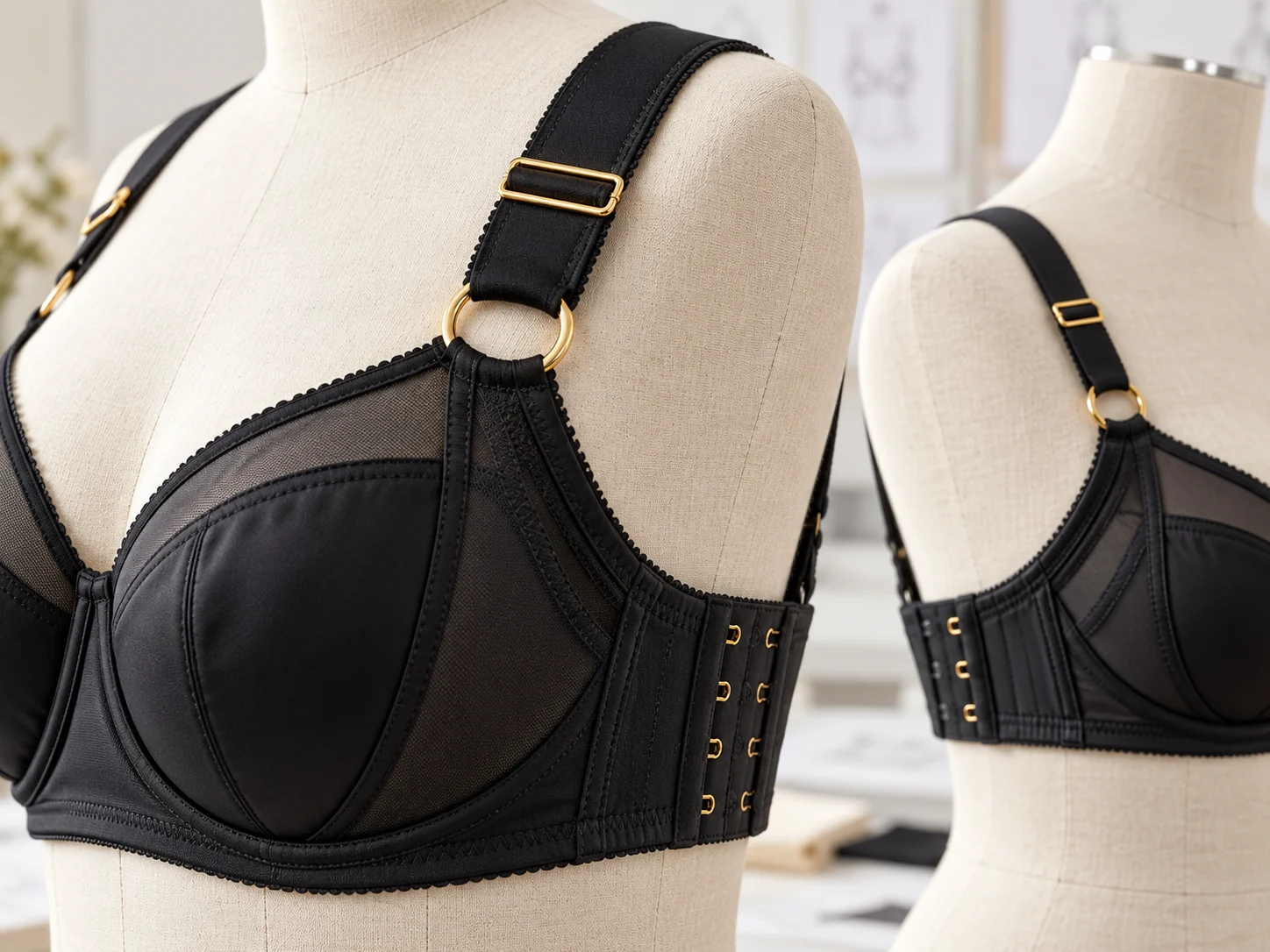
When a bra is extended into fuller cup sizes, the pattern is not the only part that should be graded. The load-bearing hardware must change with the garment.
A full-bust bra can look correct on the fitting table and still develop problems in wear: a slider moves under tension, a back closure rolls, an underwire creates pressure or an elastic connection deforms too quickly. These can appear to be fit issues, but the root cause may sit in the hardware system.
Pattern grading and hardware grading answer different questions
Pattern grading asks how the garment dimensions change. Hardware grading asks how the load changes. Larger or fuller sizes can introduce higher strap tension, wider elastic, greater support demand and more pressure at each connection point.
Keeping the same ring, slider, hook-and-eye closure or underwire throughout a broad size range may preserve the collection's appearance, but it does not guarantee consistent performance. True size inclusivity requires every structural component to be reviewed with the intended size range.
Rings and sliders must work with the strap
In full-bust lingerie, a slider does more than adjust length. It must hold its position under repeated tension. Failure is often gradual rather than dramatic: the component does not break, but the strap slowly slips during wear.
The ring and slider should be assessed together with strap width, elastic thickness, recovery and support level. Inner opening, centre-bar geometry, wire diameter, edge smoothness and surface finish all affect how the strap system behaves.
Closures distribute load
The hook-and-eye closure is part of the back support structure. If it is narrower than the back wing or too flexible for the load, tension can concentrate at the closure, contributing to rolling, instability and discomfort. More rows are not automatically better; closure width, tape structure, softness and hook consistency must match the garment.
Stronger is not always better
Underwire selection illustrates the same principle. A fuller bust does not simply need a harder wire. The wire must hold and recover its shape while matching the breast root, cradle, cup grading, fabric tension and comfort target. Excess rigidity can create pressure just as insufficient strength can reduce support.
Review the system before final trim approval
Before extending a style into fuller sizes, product teams should review:
- whether the slider holds under the actual strap tension;
- whether ring structure and opening suit the strap width;
- whether closure width follows the back wing and support level;
- whether underwire curve, recovery and tip treatment suit each cup range;
- whether finishes remain smooth after repeated wear and washing.
The goal is not to make every component visibly larger. It is to select the right structure for each load range while preserving a coherent design language.
Inclusive sizing needs inclusive engineering
A full-bust bra should not feel like a standard bra enlarged beyond the limits of its original components. The most successful extended-size products feel intentional because pattern, fabric, elastic, wire, rings, sliders and closure have been developed as one system.
Support is rarely created by one large decision. It is built through many small, correct decisions that continue all the way into the hardware.
This website article is adapted from Mike Zhao's LinkedIn Newsletter. Read the original LinkedIn article.
Extending a lingerie style into fuller sizes?
Share the size range, strap and closure specifications, elastic references and support target. We can help review the hardware as part of the complete garment system.
Discuss your project