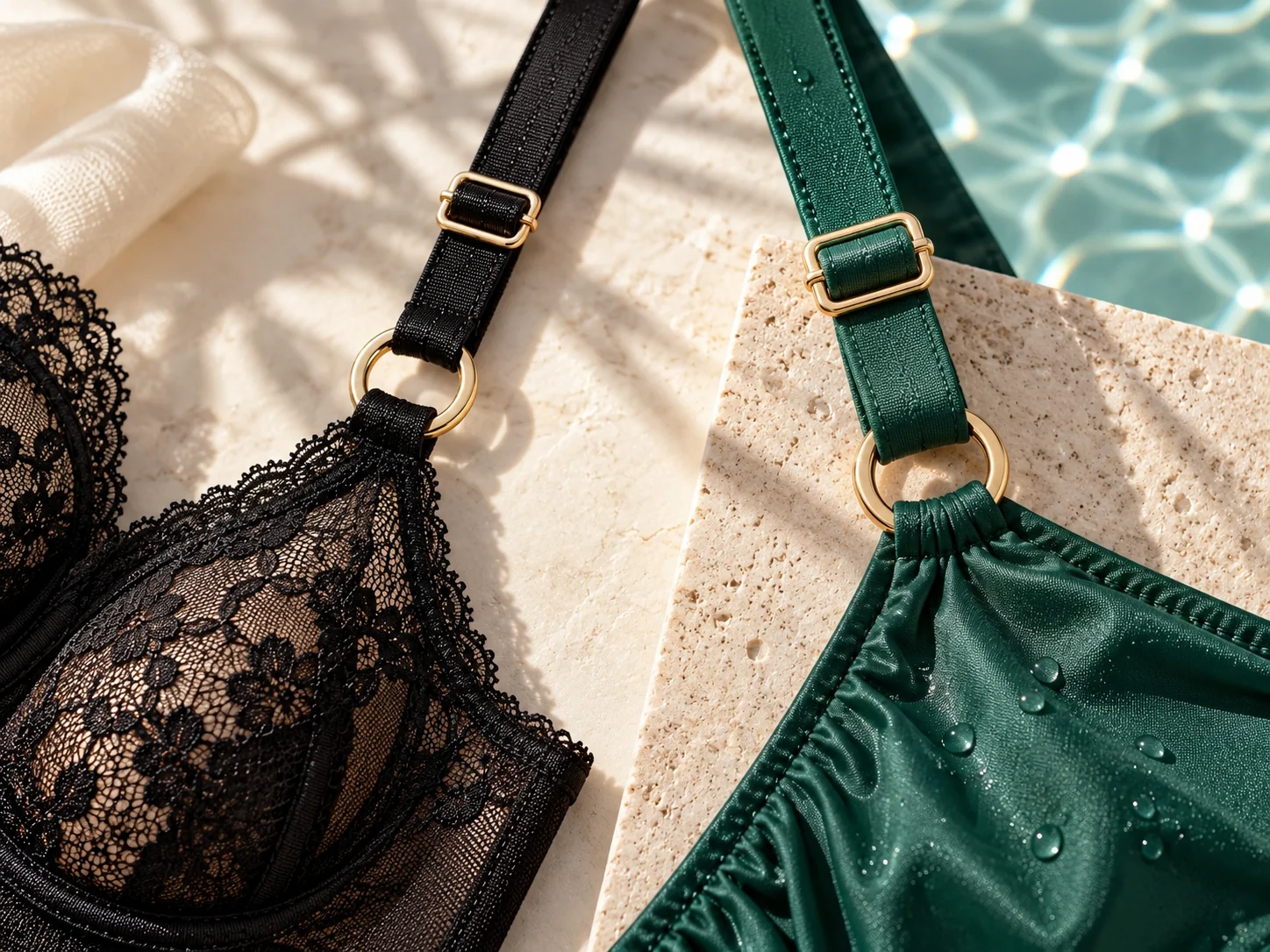
A ring, slider or logo charm can look right on both lingerie and swimwear. That does not mean it is engineered for both.
Accessories are often approved first by appearance: the shape is balanced, the colour fits the collection and the sample photographs well. The more important question comes earlier: where will the trim actually be worn?
Lingerie and swimwear use many of the same component names, but the environment around those components is different. That difference should shape the material, construction, finish and validation plan.
Same shape, different working conditions
Lingerie hardware normally works close to skin and soft elastic in a relatively controlled environment. Comfort, smooth edges, low weight and compatibility with the strap or fabric are central. A slightly rough inner edge can abrade elastic. A charm that is too heavy can distort a delicate garment. A closure that feels too rigid can change the entire wearing experience.
Swimwear adds a different set of demands. Hardware may be stretched while wet and exposed to chlorine, saltwater, sunscreen, heat, sunlight, sweat, sand and repeated wet-dry cycles. A finish that performs well on lingerie may not provide the surface stability required for a bikini or one-piece swimsuit.
Plating is a performance decision
Gold, silver, gunmetal or matte black may begin as colour choices, but for swimwear the finish is also part of the protective system. Base material, pre-treatment, plating build, sealing and the brand's testing requirement all matter.
Two parts can look nearly identical in a development meeting and still behave differently after exposure. “Same colour” does not automatically mean the same process, and the same process should not be assumed to deliver the same performance in every application.
Review the trim as part of the garment
A 12 mm slider is not only a 12 mm slider. Its performance depends on the strap width and thickness, elastic recovery, fabric, expected movement, finish and contact with the wearer. A logo charm for a bralette and the same logo charm on a bikini tie carry different risks even when the artwork is identical.
Before approval, product teams should confirm:
- the end use and expected exposure;
- the base material and finish specification;
- comfort, edge smoothness and component weight;
- compatibility with the actual fabric or elastic;
- the relevant corrosion, wash, chlorine or brand-specific tests.
The better approval question
The most expensive failure is often delayed. A sample looks perfect in the meeting, but the issue appears during testing, after shipment or in real use. That is why accessory development should not be left until the garment is otherwise complete.
Instead of asking only “Does it look good?”, ask: “Can it perform where the garment will actually be worn?” That one question helps turn a decorative detail into a reliable part of the product.
This website article is adapted from Mike Zhao's LinkedIn Newsletter. Read the original LinkedIn article.
Developing hardware for a specific garment?
Share the application, strap or fabric reference, target finish and testing requirement. SANYE can support development from drawing and tooling through sampling and bulk production.
Discuss your project