
 中文
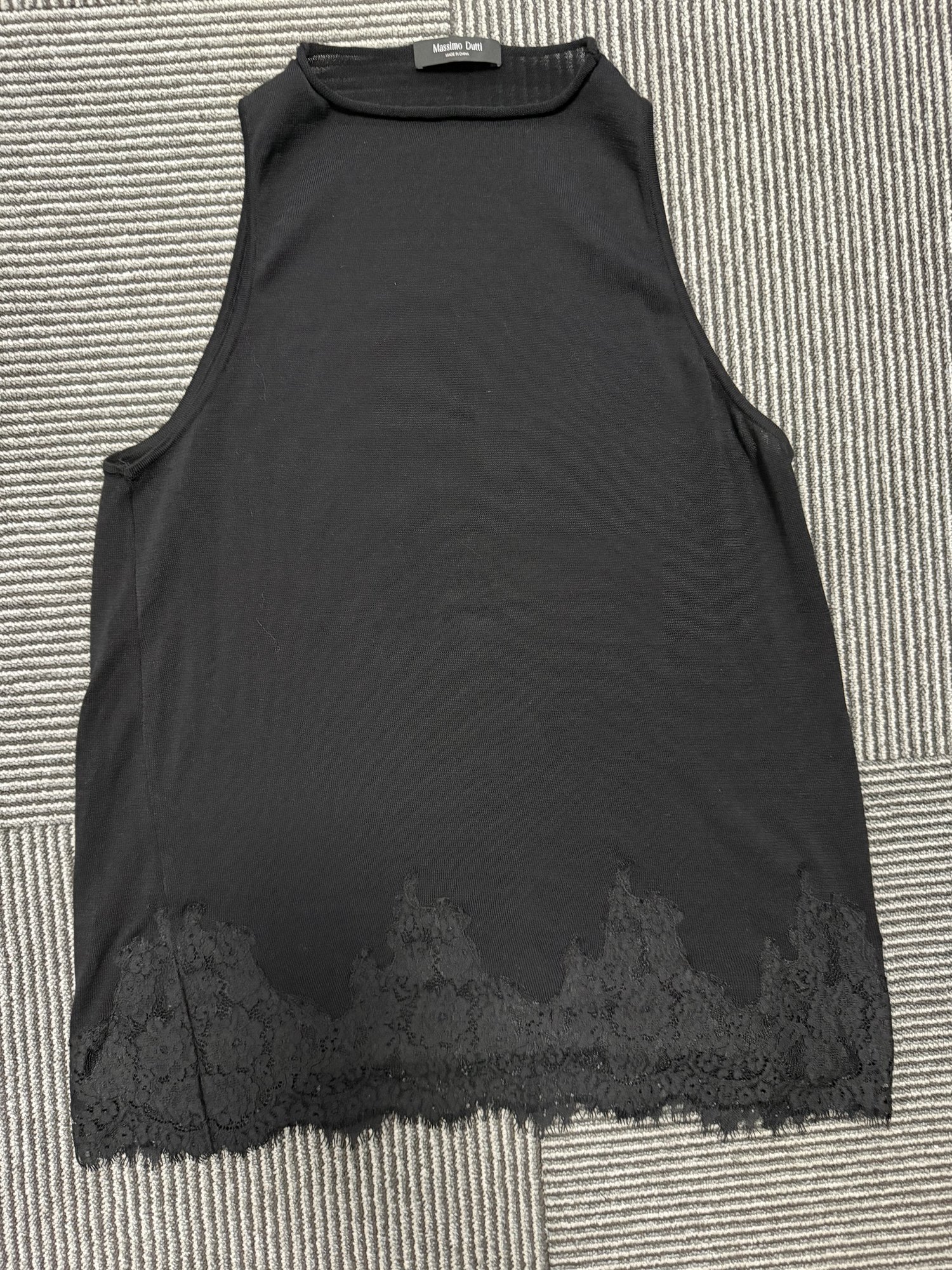
Combining knitwear with lace usually involves sewing a decorative lace section to a knitted garment body. Development should define the body yarn, knitted structure, lace proportions and seam requirements together, then confirm the settings through knitting trials, sewing trials and aftercare checks. A yarn count or stitch length alone does not define the finished result.
Garment reference: a knitted body with a lace hem
The reference photograph shows a black sleeveless knitted body with floral lace at the hem. The relatively uniform body texture contrasts with the floral motifs and scalloped lace edge. Useful visual references include the exposed lace depth, the upper boundary of the lace against the body and the balance between the two sides.
A photograph can support a discussion of placement and proportions. Fibre composition, yarn count, twist and stitch construction require material specifications, physical inspection and sampling records. The parameter examples below explain how to document development decisions; they are not measured specifications for the garment pictured.
Yarn count: identify the system, ply and number of ends fed
Yarn count describes linear density. In indirect systems such as Nm and Ne, a higher number indicates a finer yarn; in tex, a higher number indicates a coarser yarn. A brief should identify the system and yarn construction rather than simply stating “30 count”.
CottonWorks illustrates the distinction using Ne 24/1 and Ne 48/2: a 24-count singles yarn and two 48-count singles plied together have equivalent nominal linear density, but different yarn constructions. Equivalent count does not establish an identical fabric appearance. Yarn count and ply: CottonWorks
Record plied yarn construction separately from the number of ends fed together during knitting. Also specify machine gauge and knitted structure. Yarn count, knitting machine gauge and sewing stitch length describe different things.
- Yarn record: composition, supplier reference, count system, ply, colour and lot.
- Knitting record: number of ends fed, machine gauge such as needles per inch in the E system, structure and fabric density measurements.
- Approval reference: a swatch after the planned finishing process, reviewed against dimensional, handle and texture requirements.
Yarn twist: record TPM, direction and the associated count
Twist can be expressed as turns per metre (TPM) or turns per inch (TPI); 1 TPI is approximately 39.37 TPM. Record singles twist and ply twist separately, with the S or Z direction. “Soft twist” or “hard twist” alone is not a reproducible specification.
In its wool-spinning training, Woolmark uses the metric twist factor α = TPM ÷ √Nm to explain why count matters when comparing twist. As a calculation example, an Nm 30 singles yarn at α = 75 gives approximately 411 TPM. This illustrates a relationship between parameters, rather than a universal recommendation for cotton, viscose, blends or knitted cover-ups. Twist and metric twist factor: Woolmark
Request count, twist and direction data from the yarn supplier and compare candidates under consistent knitting and finishing conditions. Review the finished texture, handle, dimensional change and any panel skew instead of selecting a yarn by its twist number alone.
Lace placement: define the design before the sewing trial
A development drawing should identify total lace width, exposed depth, overlap or seam allowance and the seam position. For a decorative hem like the reference, also consider motif orientation, visual balance and how the pattern meets at the side seams.
Where the garment needs to stretch, assess the lace and knitted body in the direction of the join before choosing a seam. Linking knitted panels and attaching a lace accent are separate operations requiring separate specifications.
Sewing parameters: document stitch type, needle and density together
Coats’ intimate-apparel guide provides a useful example of a parameter combination: stitch type 308, a zigzag cross stitch, with Nm 70–75 needles, Tex 24 thread and 5–7 stitches per 3 cm. Some knitted applications for four-thread overedge stitch 514 in the same guide use 14–16 stitches per 3 cm. These are different operations; their stitch densities are not interchangeable. Stitch, needle and density references: Coats
These figures come from a specific intimate-apparel application and provide discussion references for sewing trials, not default settings for every knit-and-lace combination. Heavier panels, open structures and different lace constructions require trials with the actual materials. Needle size Nm also has a different meaning from yarn count Nm.
- Record stitch number, machine and needle system, point type and needle size. A suitable ball-point needle is commonly evaluated for knitted materials.
- Specify needle and bobbin or looper threads and stitch density. For zigzag seams, record width; for overedge seams, record trimming and overedge width.
- Keep trial records of thread tension, presser-foot pressure and feed settings. Inspect for waviness, puckering, skipped stitches, thread breakage and needle damage.
- Establish production settings from the approved trial, retaining front and reverse photographs and material lot references.
Aftercare checks: assess both materials and the seam together
The trial should use the actual body knit, lace and intended sewing threads, treated according to the proposed care method. Record body dimensions, exposed lace depth and seam appearance before and afterwards. Look for incompatible dimensional change, waviness, needle holes or distortion of the decorative edge.
For joins that stretch during dressing or wear, assess seam extension and recovery in the relevant direction. Define care conditions, dimensional tolerances and seam requirements for the project. An appearance review alone does not establish tested performance.
Common development questions
Can yarn count and twist be identified from a garment photograph?
Not reliably. Images help communicate style, placement and texture. Yarn count and twist require supplier specifications or evidence from physical testing.
Does lace always need an overedge seam?
No. Applied decoration, edge attachment and panel joining need separate assessment. Choose the stitch around the lace edge, seam allowance, appearance and required extension, then confirm it through sewing trials.
What should a factory receive in a development brief?
Provide a style drawing, yarn specification or sample, knitted structure reference, lace article and width, placement and seam drawings, proposed care method and sample approval requirements. List unresolved settings as trial items and record the decisions on the approved sample.
Taking the brief into sampling
SANYE develops knitted cover-ups for swimwear and resortwear collections. Share your design references and lace accent ideas to discuss the body, decoration and sampling requirements. Read the customer visit to our knitting production line or explore our knitted swimwear cover-ups.